
case study
AI-Driven SDLC Transformation
Proof-of-Concept
Role
Test Consultant
Client Type
DACH Financial Institution
Introduction
Our engagement with a leading DACH financial institution focused on implementing an AI-augmented software development lifecycle (SDLC) to set new benchmarks for delivery efficiency. By shifting to the MAIN Next® framework, we established a seamless partnership between developers and on-premises agentic models.
Primary Business Objectives
- Increase delivery capacity by at least 20%.
- Ensure 100% EU data residency and avoid vendor lock-in by utilizing open standard infrastructure.
The Challenge
Transforming the SDLC process and dramatically accelerating the pace of coding exposed several operational and tooling constraints that needed mitigation:
- Mind-set Shift: Developers needed to adapt to treating scope as fluid rather than fixed, which required unlearning traditional sprint commitment models and embracing a more dynamic approach.
- Management Overhead: Continuous orchestration and shorter feedback loops required more active daily management compared to Scrum’s self-management principles, bringing a coordination burden to team leads.
- Knowledge Capture: AI-accelerated development risked outpacing human
documentation; teams initially struggled to maintain a shared understanding of rapidly evolving codebases.
The Solution
Our working model fundamentally reshapes the development process, dramatically compressing timelines while maintaining quality. By integrating AI capabilities throughout the lifecycle and implementing tighter feedback mechanisms, we’ve created a far more responsive and efficient delivery approach.
Key Pillars of Implementation:
1. Ultra-Rapid Prototyping: Accelerated the initial software phase, delivering a clickable
demo on Day 1 and a functional coded prototype by Day 2.
2. On-Premises AI Agents: Deployed specialized LLM agents dedicated to code scaffolding and unit test generation while running locally to maintain data sovereignty.
3. Adaptive Orchestration: Replaced traditional end-of-sprint reviews with real-time, mid-sprint Product Owner sign-offs to match the compressed feedback loop.
The Results
The AI-augmented model proved immediately viable, delivering outstanding efficiency gains and freeing developers to focus on creative problem-solving and innovation.
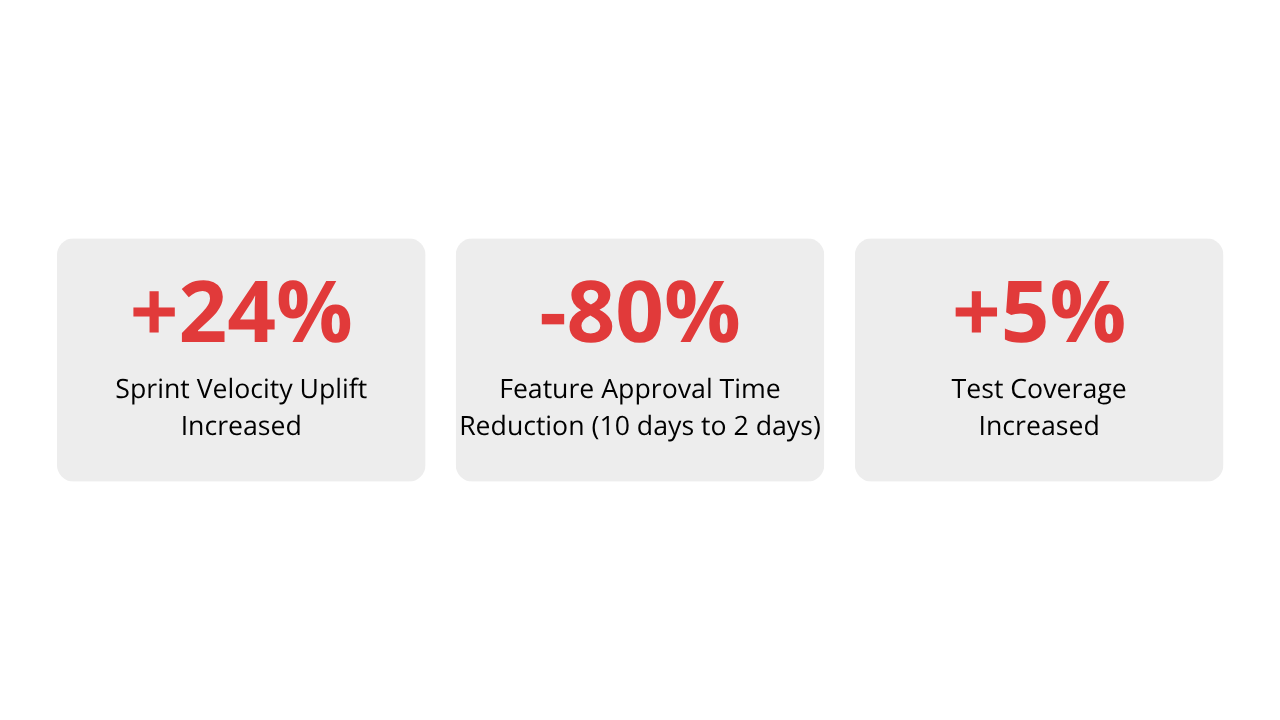
Outcome: The pilot successfully exceeded the core 20% efficiency target while maintaining high quality, leading the client to confidently expand the implementation into a full enterprise-scale program for late 2026.